
|
|


.png)


Start calculating international shipping costs from the United States. Select your destination country above, and you'll receive the price in just a few clicks.
Should I Palletize My Boxes for Shipping Overseas?
If you are sending more than three to five individual cartons or smaller items from the USA abroad, you must palletize them.
Shipping a set of loose boxes internationally is not a safe option. Some packages may be damaged, fall apart, or be lost during transit. Unsecured items are handled by hand, and there is no guarantee that they will be appropriately protected. Reliable sea freight carriers refuse to accept unpalletized cargo.
Forklifts efficiently manage palletized units during international transportation from the U.S., preventing damage and loss of goods.
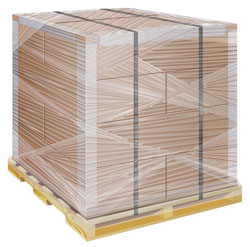
You can palletize the cargo manually or request that an ocean freight carrier secure your boxes at their freight terminal (CFS). Palletizing at a loading CFS should cost $35 to $50 per skid, including a heat-treated, certified pallet. Please remember that the more accurately your items fit into skids, the less "dead cargo volume" affects your total international shipping cost. Refer to the guidance for shipping pallets from the U.S. overseas.
The dimensions of the standard U.S. pallet used in international cargo transportation from the USA are 48" x 40" x 6" (or 1.2m x 1.0m x 0.15m). Cargo is stacked on bases and shrink-wrapped with plastic film to create "pallets" or "skids."
Although standard-sized platforms are most commonly used in global logistics, various pallet sizes and shapes are also available. Shipping skids must be strong enough to hold the loads, accessible for forklifts, and fit into 40-foot sea freight containers. Items exceeding 72" are considered oversized and subject to surcharges.
Suppose you request an ocean freight carrier's terminal (CFS) to palletize your inventory or smaller units. In that case, the CFS will appropriately stack the cargo on certified ISPM15 pallets and shrink-wrap it. Each palletized unit will carry as many shipping items as it can combine.
If you palletize your cargo on your own, then follow these LCL shipping rules:
- It is not recommended to exceed the height of the skid more than 60" (1.52m). The height of the skids depends on their load capacity and weight.
- The entire skid should be shrink-wrapped and secured with a durable plastic film.
- Bases of pallets should be accessible for pallet jacks with a minimum clearance of 3.5".
- All skids prepared for international transportation from the USA must fit into a 40' multimodal sea freight container.
- When preparing cargo for shipping from the U.S. overseas, always pay attention to ISPM15 wood packing restrictions that apply in international cargo transportation.
Sometimes, people who ship internationally ask, "Should I deliver my goods to an international shipping company freight terminal open, or can I seal them?"
The answer is yes. You can seal your containers. Only customs officials have the right to open packages during international transportation. If Customs needs to open parcels, shippers will be notified or will see special marks indicating that Customs has opened them.
For more information on professional palletizing when shipping freight from the USA, please visit our website.


