
|
|


.png)


How to Ship Commercial Cargo from the USA. Calculating international shipping costs.
LCL freight is the most affordable way to ship from the U.S. overseas
The LCL freight calculator above provides immediate access to worldwide transport rates for merchandise packed in boxes, crates, or pallets. There's no need to request quotes or wait for responses from a traditional international freight forwarder. You get transparent pricing in just minutes.
Once you've entered your details, the calculator generates an instant shipping estimate. If you're ready to move forward, you'll receive detailed logistics instructions within 24 business hours. Not ready to book just yet? No problem. You can save the quote and compare it with prices from other global logistics providers to identify the most cost-effective export solution for your needs.
To see how easy it is to use, watch our short 3-minute YouTube video. It guides you through the process and demonstrates how this tool helps reduce your overseas transport expenses while maintaining a fast and hassle-free experience.
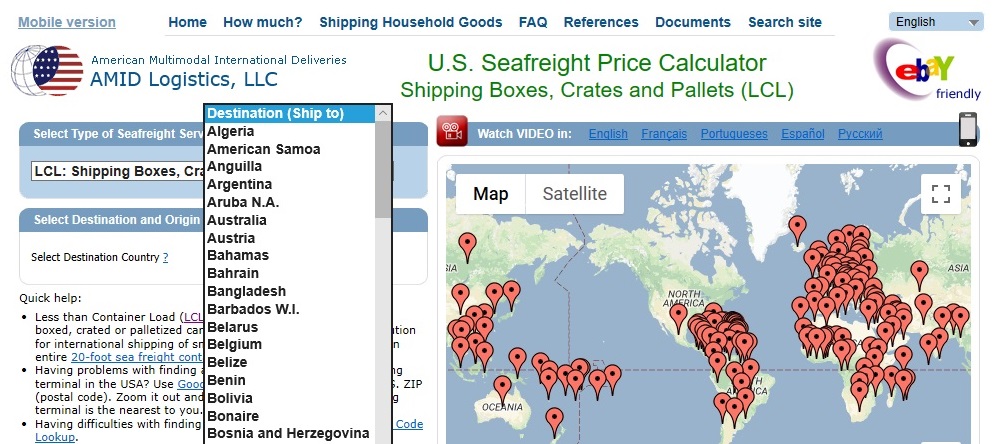
LCL is a cost-effective solution for shipping medium- to large-sized consignments from the United States to international destinations. Businesses and individuals use it for economical sea freight without the cost of a full container.
- By choosing LCL, you can reduce delivery overhead for overseas shipments, especially when managing global e-Commerce and remote orders. The calculator is ideal for coordinating inventory transfers from the U.S. while maintaining complete control over your business.
- Unlike traditional quoting methods, you don't need to rely solely on quotes from third-party carriers. The real-time calculator empowers you to manage your supply chain independently, with transparency and speed.
- For anyone involved in international commerce, especially small businesses, startups, and remote shippers, this online platform is a valuable tool. It connects you directly with trusted American ocean carriers, helping to streamline cross-border logistics. Bookmark the page so you can return anytime to quickly and confidently estimate sea freight costs.
Keep in mind: the basic procedures for exporting from the USA using LCL are generally the same, no matter which transportation company you choose. If you're new to the business and looking for a step-by-step tutorial, be sure to explore our beginner-friendly guide on how to ship overseas using LCL. It's packed with valuable tips to help you start strong and save money.
- Transit time.
- DESTINATION CHARGES.
- Cargo deliveries at destinations.
- Weight/measurement discrepancy. 75% deposit.
- LCL Vs. FCL and parcel services.
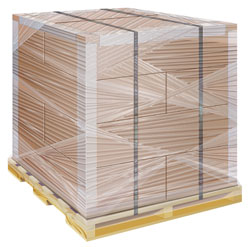
1. Ensure that all your goods are appropriately packed.
If you ship goods from the USA overseas using LCL, they must be packed in cardboard boxes, stacked on pallets, and shrink-wrapped or crated. The best way to ship items overseas is in the original manufacturer's packaging.
If you are outside the U.S. and order from a U.S. seller, ensure they pack your order properly to meet the requirements of the international shipping carrier. Then, clarify with the U.S. seller whether they offer delivery orders within the USA.
All loads must be palletized if they contain more than 3-5 boxes. You can palletize it at your warehouse. Otherwise, the ocean carrier terminal (CFS) will palletize your boxes at a fee of $35-$50 per pallet. For more information on palletizing items for moving from the USA, please visit our website. Remember that an improper box setup can add dead volume to your shipment and increase costs.
If your order contains dangerous goods, before purchasing them for shipment abroad from the USA, request that the seller provide a Dangerous Goods Declaration in the proper form. The DG declaration must be reviewed and approved by the ocean carrier. Otherwise, please refrain from purchasing them. They cannot be shipped overseas without a value declaration.
Do not try to ship prohibited commodities. If you are unsure about the legality of exporting things, please double-check with the relevant officials in the U.S. and your destination country.
2. If you requested a pickup, please be prepared to meet the driver and assist with loading into the truck, if necessary.
If you need to pick up your load at your business location, please select a pickup option in our online freight calculator. The cost of international shipping will include U.S. domestic cargo transportation.
Businesses with loading docks should expect regular pickups from a less-than-truckload (LTL) domestic carrier. The load will then be delivered to a seaport carrier's (CFS) terminal for onward movement from the USA.
Smaller businesses without loading docks should be aware of some limitations in LTL freight. LTL is mainly designed for cargo pickups at commercial facilities with loading docks. There will be only one pickup driver for your pickup. LTL drivers may refuse to handle multiple boxes, as moving numerous items is not part of their job. You may request a liftgate for the pickup of heavy items. Ordering liftgate pickup trucks incurs an additional cost of approximately $100 per pickup and is not included in the quote calculated through our online freight calculator. Please be prepared for pickup. You may need to call the LTL dispatcher to discuss and conduct your pickup conditions in advance.
Please inform the LTL company dispatcher if your order is not ready for pickup on the scheduled day. Otherwise, a charge for an attempted pickup may be added to your international shipping cost.
When calling, refer to your pickup reference number. It is in our instructions. Obtain a new pickup reference number and notify us promptly. No changes are required to your LTL bill of lading. Use the same LTL bill of lading you received, as instructed.
3. Cargo delivered to a Line-Haul terminal may need temporary palletizing.
If you self-deliver your load to a line haul terminal for transfer to a sea freight carrier's (CFS) terminal and your boxes are not palletized, you should be prepared to handle palletizing at the Line-Haul terminal.
Remember that in our online calculator, LTL line haul terminals are listed in lowercase with an asterisk (*). Daytona Beach, FL*, for example.
Based on our experience, unlike CFSs, LTL line-haul terminals are not required to palletize. However, they typically temporarily palletize loose items for forklift handling. Unlike CFS, they do not follow ISPM15 rules, which do not apply to U.S. domestic cargo transportation.
Sometimes, a line-haul terminal may charge a fee to palletize loose boxes or require them to be palletized for transport. Contact the terminal in advance to discuss palletizing arrangements and avoid confusion. When calling, always provide the LTL bill of lading number. The LTL BOL is attached to our instructions.
4. Submit all necessary documents on time.
When shipping goods from the USA abroad, remember that all sea freight carriers follow the rule "No docs, no ship!" Freight cannot be released unless all documents are in order. There are no exceptions.
Suppose the export documents are missing. In that case, the cargo will be put on hold until all required documentation is submitted. If the shipper decides to return the load, they will be charged an in/out fee and storage charges (if any).
Ensure all required documents are submitted before the cargo delivery date!
Do not include original documents with your load. Submit all documents as PDF attachments via email. Files in formats other than PDF may be rejected.
When shipping internationally, you typically need only a commercial invoice and a packing list. This should list the items and their corresponding values in US dollars.
If you cannot provide a commercial invoice, you may substitute a Valued Packing List. It serves as a pro forma commercial invoice. Our instructions will include a link to submit your packing list online. You can view your valued packing list here.
Ocean freight carriers may request additional documents for U.S. exports, such as a copy of a photo ID or tax information. Providing these documents should not cause any issues.
However, some countries may require specific documents to import goods into their territory. Before exporting goods from the United States to a particular country, we recommend contacting the country's consulate or officials to determine if any import restrictions apply. We also recommend considering Intertek.com for documents and regulations related to your global trade.
Please note that if the value of your shipment exceeds US$2,500, you must submit the U.S. Shipper's Export Declaration (SED). If you have submitted the Shippers Export Declaration yourself, provide the ITN. Otherwise, we will file it for a $35 fee. To submit the SED on your behalf, we will need either the shipper's EIN (U.S. tax ID) or a copy of the shipper's foreign passport.
Please note that a U.S. freight forwarder's responsibility is to assist a shipper until exporting goods enter the commerce zone of the destination country. In other words, freight forwarders dispatch shipments to a bonded warehouse (CFS) in the country. All issues related to import recovery, including providing all required documents and complying with the requirements of other government agencies overseas, are the consignees' responsibilities (for customs clearance, referred to as 'Importer of records'). Neither the freight forwarder nor the ocean carrier can assist you.
When shipping goods abroad with LCL, unlike with FCL, you always have a destination agent assigned by your sea carrier. Your bill of lading will include the agent's contact information. The agent should issue an official arrival notice to your consignee and guide the consignee through the complexity of your import recovery.
5. Ocean freight cannot guarantee transit time.
Generally, vessels depart from the U.S. and arrive at their destinations on schedule. You may reply to the quote obtained in our online calculator and ask for the nearest vessel schedule. However, if your shipment is time-sensitive, be aware of potential delays.
Severe weather conditions are not the only reason for a possible delay. Transit time depends on cargo and document cutoffs at the CFS, trucking or rail traffic, hubs, seaport connections, and other factors that may affect transit time.
There may be delays due to U.S. Customs and Border Protection quarantine. In such cases, the shipment cannot be loaded until the CBP releases it. There may be additional charges for the examination, which should be divided equally among all owners who participated in sharing the container. Unfortunately, no one can assist with these charges, and any complaints should be directed to CBP.
6. DESTINATION CHARGES
When involved in global trade, be aware that all imported goods are subject to destination charges, regardless of the commodity and mode of transportation.
The charges (sometimes referred to as local charges) are assessed at the destination and are NOT included in the price quotes from the online freight calculator.
Our customers are reminded of the charges throughout the shipment process. Shippers must agree with this statement when booking: 'I understand that Destination charges are payable by the consignee...'. Otherwise, shipments cannot be initiated. You can find more information about local charges in the step-by-step guide, specifically in step 7.
Once goods exit the U.S. Commerce zone, they are no longer subject to U.S. laws. The consignee is responsible for import recovery and all associated charges. Neither a U.S. freight forwarder nor an ocean carrier can assist with import recovery overseas.
In LCL, unlike FCL, an ocean freight carrier's overseas agent is assigned to meet a container that contains consolidated cargo. The agent removes the container from the container yard, de-consolidates it, and keeps it in bond at a Customs Supervised Warehouse (CFS) or transfers it to the delivery location specified in your bill of lading. Usually, the agent is a customs broker who will guide your consignee in the import recovery procedures. The agent charges your consignee for the job.
When importing goods through LCL, you must initiate the recovery process with the ocean carrier's agent, even if you have a customs broker on your staff.
Please use our online calculator to request a quote and receive the overseas agent's contact details. We can't provide routing information without a quote or booking reference number. Remember to obtain a quote or booking reference number before requesting the agent's contact information.
Remember that a portion, or all, of the local charges may be required to be paid at the port of entry, but not at the place of delivery. The shipment will then proceed to the terminal specified in your bill of lading and be cleared by customs. Otherwise, it can be transferred to the final destination on a bond and must be cleared with customs at a bonded terminal within the delivery area.
Also, remember that local charges may be billed separately to specific parties involved in import recovery.
If, for any reason, you experience difficulties in the recovery of your order overseas, then we'd suggest:
-
Suppose the carrier's agent does not contact your consignee within a few days of your shipment's estimated arrival date (ETA). Do not wait. Contact them first. The agent's contact information is in your bill of lading.
-
Request a legal Arrival Notice. Your arrival notice must be dated, include the agent's letterhead, and include a detailed breakdown of local charges. Phone calls or random emails are not enough.
-
Follow the agent's instructions. Pay applicable charges, and receive your released goods.
-
If you experience difficulties with recovering an order at the destination, please don't hesitate to contact us. However, if you do not provide a copy of your legal arrival notice, we will be unable to work with the ocean freight carrier on your behalf. We will always need a copy of your legal arrival notice.
Import recoveries should be handled promptly to avoid penalties, including storage, demurrage, and Customs fees, that may be incurred due to deadlines.
7. Door deliveries at destinations.
It's important to note that LCL shipments do not include a 'door delivery' service. Instead, your order will be delivered to a terminal located within the specified city area on your bill of lading. Please keep this in mind when planning for your shipment's arrival.
If you can't send a pickup truck, many sea carriers offer delivery services for an extra fee. You can order a 'door delivery' and pay the fee overseas.
8. 75% deposit. The actual international shipping cost may differ from the estimated cost.
When initiating a shipment, you must prepay 75% of the estimated international shipping cost, based on the weight and measurements provided in your quote and booking.
When booking your LCL shipment, it's acceptable to estimate the dimensions, weight, and quantity.
Upon delivery to the ocean carrier's terminal (CFS), the CFS will re-measure and confirm your cargo's quantity, volume, and weight. You should also read this step-by-step guide.
Additionally, you can expect our final invoice, less the deposit already paid, not upon arrival of your shipment at the destination, but rather when it departs from the USA. In other words, we will invoice you when your sea freight bill of lading is generated. Occasionally, if we receive a rated proof copy of your bill of lading before departure, we may invoice you based on it.
Your invoice will be based on the actual weight and volume of your load, not the estimated provided during quoting and booking. The invoice may also reflect unaccounted-for carrier costs not included in the initial booking (if any), such as palletizing, fumigation, and GRIs incurred during the shipment. You'll pay for what you shipped, not what you estimated would ship. If you overestimated your w/m, you pay less or receive a refund. If you have underestimated your w/m, you pay more. That's why we request a 75% deposit rather than 100%.
9. Do not confuse LCL service with parcel services. The minimum charge is one cubic meter. Destination charges.
When using LCL, remember that it is designed to ship relatively large loads. In LCL, there is always a minimum charge of one cubic meter. In other words, if your total cargo volume is less than one cubic meter, you will be charged the volume of one cubic meter anyway. Specific countries may have minimums of two or three cubic meters.
When using our online freight calculator to determine international shipping costs, the price remains the same for shipments under one cubic meter. However, the price will increase once the volume exceeds one cubic meter.
Also, there are always destination charges.
If you ship small items via parcel services such as FedEx, DHL, or Amazon, it is likely more convenient and cost-effective. However, if you ship relatively large or heavy items from the U.S., LCL becomes much more cost-effective.
LCL is a cost-effective shipping solution for transporting relatively large cargo from the USA abroad, making it a popular choice for businesses focused on affordable international shipping.
Frequently Asked Questions (FAQ)
1. How do I choose the right international shipping company?
Selecting the right global transportation company is crucial to ensuring safe, timely delivery. Look for a licensed ocean freight forwarder with experience in handling commercial shipments. AMID Logistics specializes in exporting commercial cargo from the USA using reliable sea freight services.
2. What factors influence sea freight rates?
Sea freight rates depend on several factors, including the size (volume), destination, type of goods, and whether cargo is delivered to a terminal or a pickup is requested. Our online freight calculator provides accurate rate estimates based on your shipment details.
3. How can I reduce my costs when moving goods from the USA overseas?
You can reduce your international shipping costs by consolidating your shipment with other shippers using LCL. Additionally, delivering your load to a terminal yourself, rather than requesting pickup, often results in significant savings.
4. Do global transportation providers handle all types of commodities?
International shipping companies should handle a wide range of commercial goods, including machinery, industrial equipment, textiles, and consumer products. However, hazardous materials and restricted goods may require special documentation or handling.
5. How accurate is your calculator?
Our online calculator provides international freight rates based on real-time carrier tariffs and market conditions. We aim to offer transparent, competitive pricing with no hidden charges.
6. What documents are needed to ship internationally?
To ship commercial goods, you typically need a commercial invoice, packing list, and an ocean freight bill of lading. Depending on the destination, some shipments may also require certificates of origin or specific customs documents.


