
|
|


.png)


The online freight calculator above provides a quick estimate of international shipping costs for cargo deliveries from the United States.
Cargo Deliveries and Pickups in Shipping from the USA Overseas
International shipping costs are based on the service selected: Self-delivery or Pickup.
When calculating international ocean freight rates to deliver your goods from the USA overseas, you can either self-deliver your cargo to a carrier's export hub or request that the carrier pick up (collect) your packed goods at your location. Transportation procedures and associated costs vary significantly by option.
The online calculator provides three options when quoting and booking an overseas shipment.
Three Ways to Deliver a Load to a CFS
Here are the options:
-
Self-deliver your freight directly to an ocean carrier's receiving station (called CFS - Container Freight Station). This is the most affordable method for international shipping.
-
Self-deliver your consignment to the nearest U.S. domestic logistics facility, then line-haul the shipment to a CFS in the United States. Typically, that will be a U.S. domestic LTL carrier's warehouse.
-
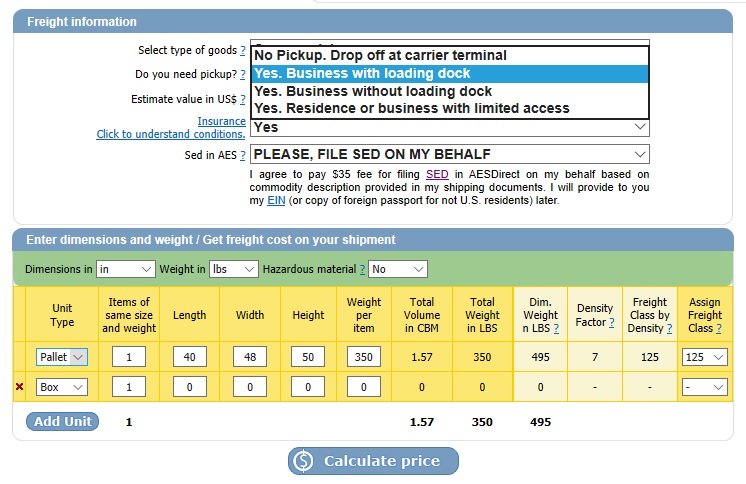
Request a carrier pickup of packed goods at your specified location for international delivery.
The First Option. Direct delivery to a CFS.
You deliver your packed goods to the nearest ocean freight carrier facility. Such hubs are known as Container Freight Stations (CFS).
Our calculator lists CFS locations in uppercase and highlights them. CHICAGO, IL, for example.
By delivering a shipment to a CFS, you submit your items directly to a sea freight carrier. A single carrier will handle the entire maritime transport process. Rates should be calculated in cubic meters or cubic feet. The remainder of your transit, until it arrives at the delivery location specified in your bill of lading, will be under the supervision of a single carrier.
The CFS can properly palletize goods delivered to the warehouse, including boxes and other smaller items, on certified pallets.
Self-delivery to a CFS is the most cost-effective way to export cargo from the U.S. to overseas destinations.
The Second Option. Delivery at Line Haul.
Suppose a CFS is too far away. In that case, you can deliver your inventory to the nearest U.S. domestic Less Than Truckload (LTL) drop-off point, then transfer it to a Container Freight Station (CFS) for further overseas shipping.
We refer to such facilities as Line Haul terminals. Our online calculator displays line haul sites in lowercase with asterisks ()—for example, Denver, CO.
If you deliver a load to a line haul location, a line haul charge will be added to the ocean freight. U.S. domestic ground transportation prices are calculated on a per-kilo or per-pound basis. The LTL rates depend on Freight Class and the U.S. National Motor Freight Classification (NMFC). Rates for moving freight from a line haul hub to a CFS are calculated based on the dimensional weight of the load.
Typically, line-haul sites temporarily palletize all shipments for easier transport at no additional charge. However, they never comply with ISPM 15 because it does not apply to U.S. domestic trucking. Line-haul operators may occasionally request a small fee to palletize boxes. You should pay the fee directly at the facility.
The third option. Pickup (Collection).
You can also select a professional freight pickup. You should specify the pickup location type, such as a warehouse, small-business premises, or a residential address.
Depending on the location's distance from the nearest export point, your goods will be transported to a CFS or a line-haul warehouse for further transfer to a CFS.
Pickup rates are the same as line-haul rates, based on the shipment's dimensional weight.
In our business, we typically schedule pickups with LTL cargo carriers. LTL is mainly designed for industrial transport between warehouses with loading docks. If there is no loading dock, be aware of limitations when making pickups at small business premises and residential addresses.
What is LCL Freight?
LCL means "Less than Container Load."
It is a method to ship overseas cargo that does not fill an entire container. Instead, different shippers share a container, allowing them to split the costs. This is an excellent option for small business exports that cannot fill a full container.
How It Works: When you choose LCL, your cargo is consolidated at a consolidation warehouse. There, it is combined with other shipments going to the same place. Once the container is full, it is shipped by sea. The container is opened upon arrival at the destination, and each consignment is separated for delivery to the intended recipient.
Benefits of LCL
Cost-Efficient: With LCL, you share a container with other shipments. This means you only pay for the space your cargo occupies, making it a smarter international logistics option for smaller loads than a Full Container Load (FCL).
Operational Flexibility: LCL allows smaller businesses to ship goods internationally without waiting until they have enough cargo to fill a whole container. This helps make supply chain management more efficient.
Global Accessibility: LCL enables smaller companies and e-commerce sellers to access global markets without the need for frequent large shipments.
When to Choose LCL
Choose LCL (Less than Container Load) if you don't have strict timing requirements and want to minimize shipping costs. This option is best suited for shipments of less than 15-18 cubic meters (CBM). If your shipment exceeds this limit, consider using FCL (Full Container Load), which may be the most economical overseas shipping option.
LCL lets you share a container with other shipments. This can help your business save money and increase logistics flexibility.


